
Composite Footballs vs Leather Footballs
I was out on the field recently teaching a private kicking lesson and the bag of balls given to my student by his school was hardly worth opening.
As promised by the high school coach, the kicker WAS given practice balls to use. They were just beat up leftovers as is typically at most schools. We call them ‘kicker balls’ – where team footballs are marked with a large ‘K’ and then go to die.
I decided to mix in a few of the composite footballs I had in my bag for the session to see how they felt and traveled through the air when kicked.
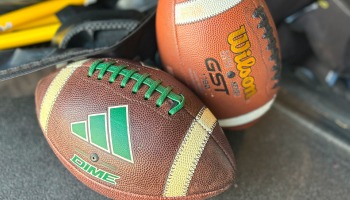
Leather Football vs Composite Football
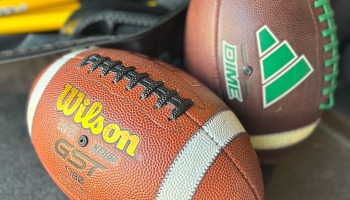
Composite Football vs Leather Football
Shown here are two footballs side for a visual comparison. They are both full size footballs that I use during student lessons.
The Adidas Dime football shown here is leather, while the Wilson GST football shown is composite.
A composite football is generally a lighter weight, less expensive ball you can find in the sporting isle at any Target or Walmart.
They are not leather, so they don’t get heavy and wet in the rain or early morning dew like leather footballs either. Though I train my students with all leather footballs these days, I do keep a separate bag of composite footballs in all sizes (what are the football sizes anyway?) for the various age groups I work with from week to week.
Composite Footballs in Games
In general, composite footballs won’t be used in a game, but more importantly (and if constrained by a budget or horrible school ‘kicker’ footballs) you will actually have new footballs that you can kick, and lots of them.
I’ll be honest about composite footballs in games. I didn’t think ANY schools did this, but just recently one of my private lesson students told me his school actually uses composite footballs in games, and they have for awhile now.
I suppose I’ll start asking other students too, but even for those students using leather footballs in games, don’t feel like you HAVE to rely only on beat up leather balls with tumors.
Should We Avoid Kicking Composite Footballs?
I’m going to say NO, and I’ve been kicking and coaching kickers for a long time.
Composite footballs are the same shape as leather footballs, and they produce the same result patterns when kicked. After all, a hook is hook, a push is a push no matter the football.
Are you tracking your practice kicks?
Most kickers don’t improve because they KICK MORE – they improve because they start noticing patterns.
Our FREE Kick Tracker isn’t just a worksheet. It’s a simple feedback system that helps spot trends over time — like pulls, hooks and inconsistent contact – so you know WHAT to work on instead of guessing.
Start Using the Kick Tracking System (PDF)
Free and easy to get started.
The fact that a composite football generally travels a few yards further when kicked is NOT a reason to avoid practicing with them. Some leather footballs travel further than other leather footballs depending on how they are prepped, prepared and worked in…..so what?
I would encourage you to simply make note of your baseline range with composite footballs so that when you try that next personal record it doesn’t artificially inflate your ego.
But, does it do any ‘damage’ to a kicker’s routine early in the kicking journey especially?
Well, when I asked my young ‘first lesson’ kicker student about which footballs out of the group (his leather versus my composite) were HIS favorites, the reply was telling I thought. “I couldn’t really tell the difference.”
 About Coach Scott
Georgia Tech Hall of Fame Member, All-American and former NFL placekicker. Scott coaches kickers (and parents) with a simple goal: building a repeatable process that holds up under pressure.